Everything we wish parents knew sooner
Start with what your child's mouth needs at their age, tap through the baby tooth chart, get the brushing and flossing routine right, then read the straight answers on habits, snacks, braces and mouthguards.

What a mouth needs, age by age
We are a pediatric practice, so the five child stages below are where our detail lives. The last two exist because parents ask us constantly what happens when a child outgrows us, and what they should be doing about their own teeth.
- 0 to 3Our patients
First tooth, first visit
The lower central incisors usually arrive between six and ten months, and all twenty primary teeth are typically in by age three.
At the practice
- Knee-to-knee exam on your lap, about half an hour
- Lift-the-lip check of the upper front gumline, where early childhood caries starts
- Fluoride varnish painted on in seconds
- A real conversation about bottles, night feeds and teething
At home
- Wipe the gums after feeds before any teeth appear
- A rice-grain smear of fluoride toothpaste from the first tooth
- Bottle finished before bed, then brush or wipe
- Move toward an open cup between twelve and eighteen months
Worth watching for. White chalky bands along the gumline of the upper front teeth. That is the earliest sign of decay and it is still reversible.
- 3 to 5Our patients
The practice years
A full primary dentition, with the spacing between front teeth that looks like a gap problem and is actually a good sign for the adult teeth to come.
At the practice
- Checkup and cleaning every six months
- X-rays once the back molars touch and we can no longer see between them
- Habit review for thumbs and pacifiers
- First proper ride in the chair, usually without a parent's lap
At home
- Pea-sized fluoride toothpaste from age three
- Twice a day, and a parent does the night pass
- Floss wherever two teeth touch
- Treats with meals rather than spread across the afternoon
Worth watching for. A thumb or pacifier habit that is still going strong at four. It is far easier to unwind now than after the permanent incisors arrive.
- 6 to 9Our patients
Wobbly teeth and new molars
The mixed dentition. First permanent molars erupt behind the baby teeth around six without anything falling out first, and the lower incisors start to shed.
At the practice
- Sealants on the permanent molars as soon as the grooves are fully erupted
- The age seven orthodontic check for crossbites, crowding and arch width
- A mouthguard scan if a contact sport has started
- Brushing coached against the new molars, which kids consistently miss
At home
- A parent pass at night until they can tie their own shoelaces, roughly seven or eight
- Flossing becomes non-negotiable where the molars touch
- New permanent teeth often come in yellower than baby teeth, which is normal
- Water between meals, not juice
Worth watching for. An adult tooth coming in behind a baby tooth that will not wiggle out. Call us, it usually needs a hand.
- 10 to 13Our patients
The last baby teeth go
Canines and premolars shed, second permanent molars arrive around twelve, and the bite settles into something close to its adult shape.
At the practice
- Sealants on the second molars
- Orthodontic timing reviewed at each checkup
- Wisdom teeth first appear on an X-ray around twelve, so we start tracking them
- Gum health check, because hormonal gingivitis begins in this window
At home
- Independence with a spot check, not a handover
- Interdental brushes or floss threaders once braces are on
- A replacement mouthguard each season, they outgrow them fast
- Sports drinks are the single biggest new enamel risk at this age
Worth watching for. Puffy gums that bleed when brushed. That is gingivitis, not a sign to brush less.
- 14 to 18Our patients
Their mouth, their habits
A full permanent dentition apart from the third molars. Enamel is mature but the diet and the schedule are working against it.
At the practice
- Checkups booked around practices and exams, including our Saturday mornings
- Whitening once growth and any orthodontic work have finished
- Wisdom tooth position reviewed and referred if they are heading for trouble
- Straight talk about vaping, energy drinks and mouth piercings, with the parent out of the room if that helps
At home
- Retainer wear if braces or aligners are done
- A guard for grinding, which shows up around exam season
- Brushing twice a day is the floor, not the goal
- Their own reminders, not yours
Worth watching for. Chalky white marks appearing around brackets. That is decalcification and it is permanent once the braces come off.
- 18 to 19Transitioning
Handing over the chart
Growth is essentially complete and wisdom teeth are the open question. From here the care a mouth needs is adult care.
At the practice
- We care for patients from the first tooth up to the nineteenth birthday
- Current patients are welcome through the summer after high school, so nobody is dropped mid-treatment
- At the last visit we send records, X-rays and a short summary wherever you ask
- We will name two or three general dentists in the Treasure Valley who we would send our own families to
At home
- Ask for a copy of the chart before a college move
- Keep the retainer, it does not stop mattering at eighteen
- Register with a dentist near campus rather than waiting for a holiday
- Know your own insurance details for the first time
Worth watching for. The gap year where nobody books a checkup. It is the commonest reason a first adult visit starts with bad news.
- Grown-upsWe refer
Parents, and grandparents
We do not treat adults, and we would rather explain what changes than pretend it is all the same. Adult mouths fail differently from children's.
What changes
- Gum disease, not decay, becomes the main reason adults lose teeth
- Dry mouth from common medications raises decay risk sharply in later life
- Decay on exposed root surfaces is a specifically older-adult problem
- Worn enamel, cracked cusps, crowns, implants and dentures are all general and restorative dentistry
At home
- The same two minutes twice a day, with interdental cleaning that actually reaches
- Tell your dentist every medication, including the ones that seem unrelated
- Book your own checkup on the same day as your child's if it helps you remember
- Ask us for a referral, we keep a short list
Worth watching for. Parents who have not been seen in years while their children never miss a visit. We see it constantly, and we will always give you a name.
The age we hand over
Little Molars treats children from the first tooth up to the nineteenth birthday. Patients already in treatment are welcome through the summer after high school so nobody is dropped part-way. At the final visit we send records and X-rays wherever you ask, and we will name general dentists in the Treasure Valley we would send our own families to.
General information, not dental advice. Every child develops on their own timetable and a few months either side of these ranges is normal.
When do baby teeth show up?
Every child is on their own schedule. Most have all 20 baby teeth by age 3, and a few months early or late is completely normal.
Pick any tooth to see when it usually arrives and when it wiggles loose.
Lower central incisor
- Usually comes in
- 6 to 10 months
- Usually falls out
- 6 to 7 years
Based on American Dental Association eruption charts. Ask us if teeth are more than 6 months early or late.
What actually matters at home
Parents are sold a lot of products. Here is the honest sort: the two things to protect on the worst evening of the week, the three that do the real work when you have the energy, and the two that are our job rather than yours.
Non-negotiable
Do these even on a bad night
Fluoride toothpaste, twice a day
The right amount for the age, and spit rather than rinse afterwards so the fluoride film stays on the teeth and keeps working.
A parent pass at bedtime
Let your child go first for the independence, then go over it properly yourself. Keep doing this until they can tie their own shoelaces.
Where cavities are won
Do these most days
Clean where two teeth touch
A brush cannot pass a contact point. Floss or an interdental brush is the only thing that reaches, and back molars are where childhood cavities start.
Keep sugar to mealtimes
How often it arrives matters more than how much. A dessert after dinner is gentler on enamel than the same sugar sipped across an afternoon.
Water between meals
Not juice, not milk, not a sports drink. Water clears acid and keeps saliva doing the repair work it is built for.
Your job is only to turn up
Leave these to us
Sealants on new molars
The grooves in a six-year molar are narrower than a bristle, so no amount of brushing reaches the bottom of them. Sealing closes the commonest cavity site in childhood.
A checkup every six months
This catches what the rest of the list missed. It does not replace any of it, which is why it is in the last group rather than the first.
Brushing, properly
- Soft bristles, a small head, and whatever handle they will actually pick up. Manual and electric both work when the technique is right.
- Angle the bristles at about forty-five degrees to where the tooth meets the gum, not flat against the tooth.
- Short gentle circles in one place before moving on. Scrubbing hard scores the gumline and cleans less.
- Four quadrants, thirty seconds each. That is what the two-minute timer is dividing up.
- Do not skip the chewing surfaces, the tongue side of the lower molars or the back of the upper front teeth.
- Spit, do not rinse. Leaving the fluoride film on the teeth is half the point of using it.
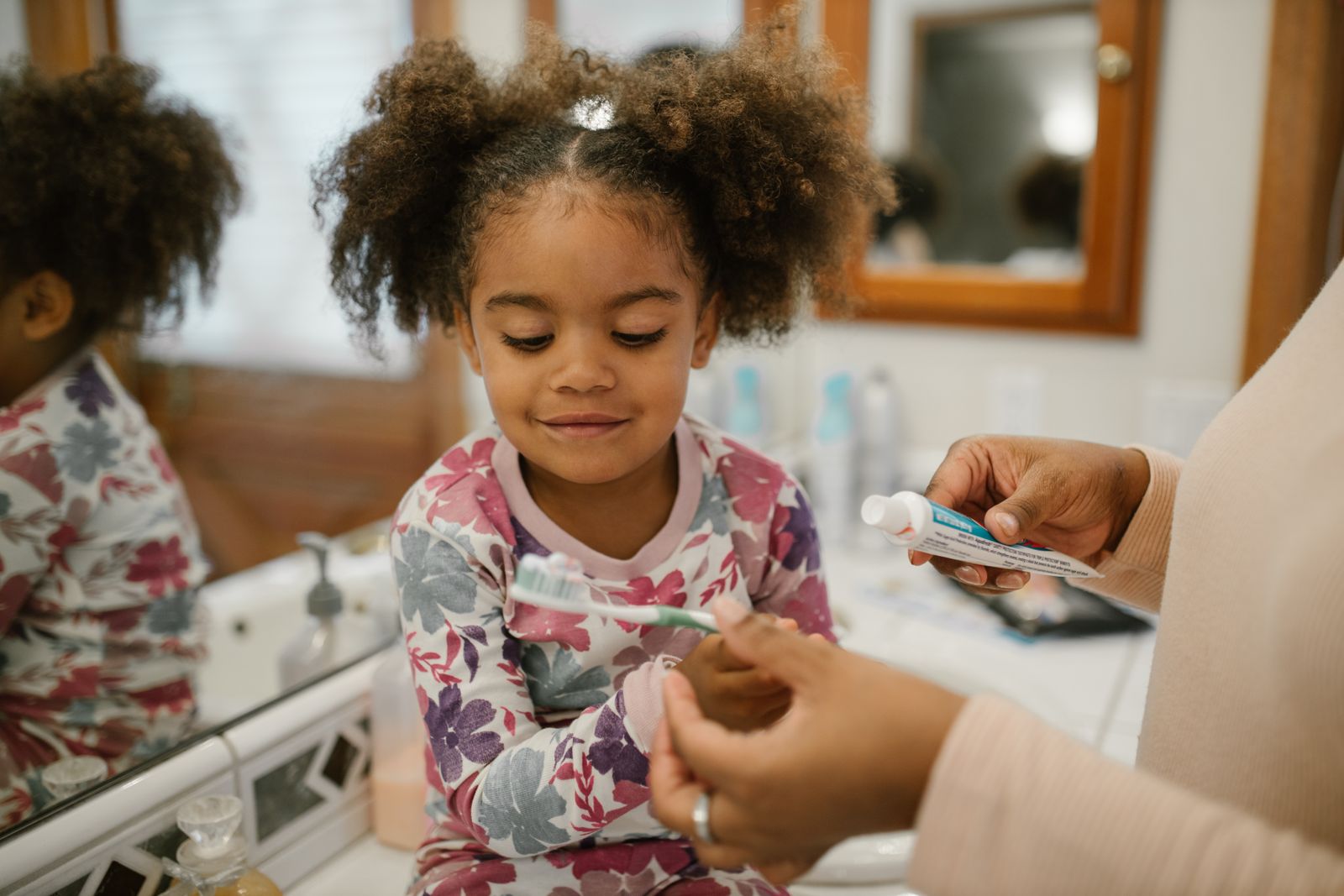
Flossing, which is where the cavities are
Start when two teeth touch
For most children that is the back molars around age two to three, long before the front teeth ever touch. Anywhere a brush cannot pass is a flossing site.
Floss picks count
The best floss is the one that gets used. Picks are easier in a small mouth and easier for a parent reaching across a wriggling child.
Hug the tooth
Curve the floss into a C against one tooth, slide gently under the gum edge, up and out, then repeat against the neighbour. Do not snap it down between them.
Once a day, at night
Before the toothpaste, so the fluoride can reach the surfaces you just cleaned.
A parent's job for longer than you think
Most children do not have the dexterity to floss properly until around ten. Before that, expect to do it.
Interdental and the extras
Useful in the right mouth, and pointless in the wrong one. Here is who each of these is actually for.
Interdental brushes
Small tapered brushes that fit gaps floss struggles with. Essential once braces are on, and easier than threading floss under a wire.
Braces, wide gaps, tweens and teensFloss threaders
A soft loop that carries floss under an orthodontic wire or a space maintainer so you can still clean the contact point underneath.
Braces and appliancesA water flosser
Genuinely useful for rinsing debris out from around brackets. It is an addition to string floss, not a replacement for it.
Braces, or a child who refuses floss entirelyFluoride mouthrinse
Worth adding from about age six, once a child can reliably spit everything out. At a different time of day from brushing, not straight after.
Higher decay risk, ages 6 and upBrushing the tongue
A gentle sweep with the brush. Most childhood bad breath comes from the tongue, not the teeth.
Any ageA mouthguard at night
Grinding is common in childhood and usually needs nothing. A guard is for teens who are wearing enamel down or waking with jaw ache.
Teens who grind
Food matters as much as brushing does. The snack swaps below are the other half of this page, and the two-minute timer above is how you make the first item on the list actually happen.
General information, not dental advice. Ask us at a checkup before starting a fluoride rinse or changing anything for a child under six.
The 2-minute brush timer
Most kids stop brushing after 45 seconds. Our timer splits two minutes into four 30-second zones, so every tooth gets its turn.
- Top leftBack molars first, little circles
- Top rightSwap sides, do not forget the tongue side
- Bottom leftChewing tops and along the gums
- Bottom rightLast zone, then spit, do not rinse
Snack swaps teeth love
It is not only candy. Sticky, starchy and sipped-all-day snacks cause most of the cavities we see. Try these easy swaps.

Timing tip: serve treats with meals, not between them. Teeth need 2 to 3 hours to recover from each snack.
The four habits parents ask about most
Teething, thumbs, pacifiers and bedtime bottles. Here is what actually matters for the bite, and what you can safely ignore.
Teething without the tears
Teething usually starts between 4 and 7 months. Drooling, chewing and fussiness are normal. High fever and diarrhea are not caused by teething, so call your pediatrician if those show up.
Worth doing
- Chilled (not frozen) teething rings
- Gentle gum massage with a clean finger
- Wipe gums with a soft cloth after feeds
Skip these
- Numbing gels with benzocaine for babies
- Amber teething necklaces (choking risk)
- Frozen rings that can bruise gums

Thumb sucking: when to worry
Sucking is a natural soothing reflex. Most kids stop on their own between 2 and 4. If it continues after permanent front teeth arrive, around age 6, it can push teeth forward and cause an open bite.
Worth doing
- Praise thumb-free moments instead of scolding
- Offer a comfort object at bedtime
- Use a sticker chart for older preschoolers
Skip these
- Bitter nail polish without talking to us
- Shaming or punishment
- Forcing it during stressful life changes

Pacifier habits and weaning
Pacifiers are easier to wean than thumbs, and they can be helpful for sleep in infancy. We suggest starting to limit them around 12 months and saying goodbye by age 2 to 3 to protect the bite.
Worth doing
- Limit to naps and bedtime after the first birthday
- Try the pacifier fairy or a trade for a toy
- Replace cracked or worn pacifiers
Skip these
- Dipping pacifiers in honey or sugar
- Cleaning a pacifier in your own mouth
- Clipping on long cords

Bottles, sippy cups and bedtime
Milk or formula pooling around teeth during sleep is a leading cause of early childhood cavities. Aim to move from bottle to open cup between 12 and 18 months.
Worth doing
- Finish the bottle before bed, then brush or wipe
- Offer only water in bedtime cups
- Practice with an open or straw cup at meals
Skip these
- Putting baby to bed with milk or juice
- Carrying a sippy cup of juice all day
- Adding sugar or cereal to bottles

Why age 7 is the number to remember
The American Association of Orthodontists recommends a bite check at 7, while the jaw is still growing and easy to guide. Most kids need nothing. For the few who do, early is easier.

- Crossbites and narrow upper arches
- Crowding with no room for adult teeth
- Front teeth that stick out or do not meet
- Jaw shifting to one side when biting
- Age 6
First adult molars
Six-year molars erupt behind the baby teeth. Perfect time for sealants.
- Age 7
Ortho screening
We check bite, spacing and jaw growth at a routine checkup, at no extra cost.
- Age 8 to 10
Phase 1 if needed
Expanders or Invisalign First guide growth, usually for 6 to 12 months.
- Age 10 to 12
Baby teeth finish
Canines and molars shed. We watch for crowding and impacted teeth.
- Age 12 to 14
Phase 2 or full treatment
Aligners or braces for teens who still need alignment.
- Age 16 to 19
Retainers and wisdom teeth
Retainers keep results. We X-ray wisdom teeth before they cause trouble.
Ages are typical ranges. Growth varies from child to child, and this is general education, not medical advice.
A knocked-out tooth costs more than a mouthguard
Kids without a mouthguard are far more likely to chip or lose a front tooth in contact sports. We scan, we fit, and your child picks the colors.
 Ready in about a week
Custom-fitWhat we make
Made from a 3D scan, thin enough to talk and breathe, in team colors. Best protection and comfort.
Boil and bite
Store-bought and molded at home. Better than nothing, but bulkier and easy to chew through.
Stock
Ready to wear, no fitting. Loose and uncomfortable, so kids tend to take them out.
Sports we fit guards for every season
- Football
- Hockey
- Lacrosse
- Basketball
- Soccer
- Wrestling
- Skateboarding
- Mountain biking
- Martial arts
- Softball
Still have a question?
Our coordinators answer parent questions on the phone all day, even from families who are not patients yet. Call us or send a note and we will get back to you.